
Beltrami County Arrest Records
Beltrami County arrest records start with law enforcement. They may include arrest, incident, booking, citation, crash, or investigative data maintained through the Sheriff's Records Office or related agencies. The Law Enforcement Center Records Office maintains initial, investigative, and criminal files for the Beltrami County Sheriff's Office, Bemidji Police Department, and Blackduck Police Department. That local detail matters because a person seeking a Bemidji or Blackduck report may still be routed through the shared Records Office.
Court charges after arrest are different. They begin when the Beltrami County Attorney or another authorized prosecutor files formal counts in District Court. The court charge record may show count number, offense description, statute, degree or severity, case number, filing date, amendments, and disposition. For booking and custody information, use the jail or Beltrami County inmate records route. For the full court case file, including pleas and sentencing, use criminal court records.
The Beltrami County Sheriff's Records Office page is assigned to the arrest and charge records manifest.
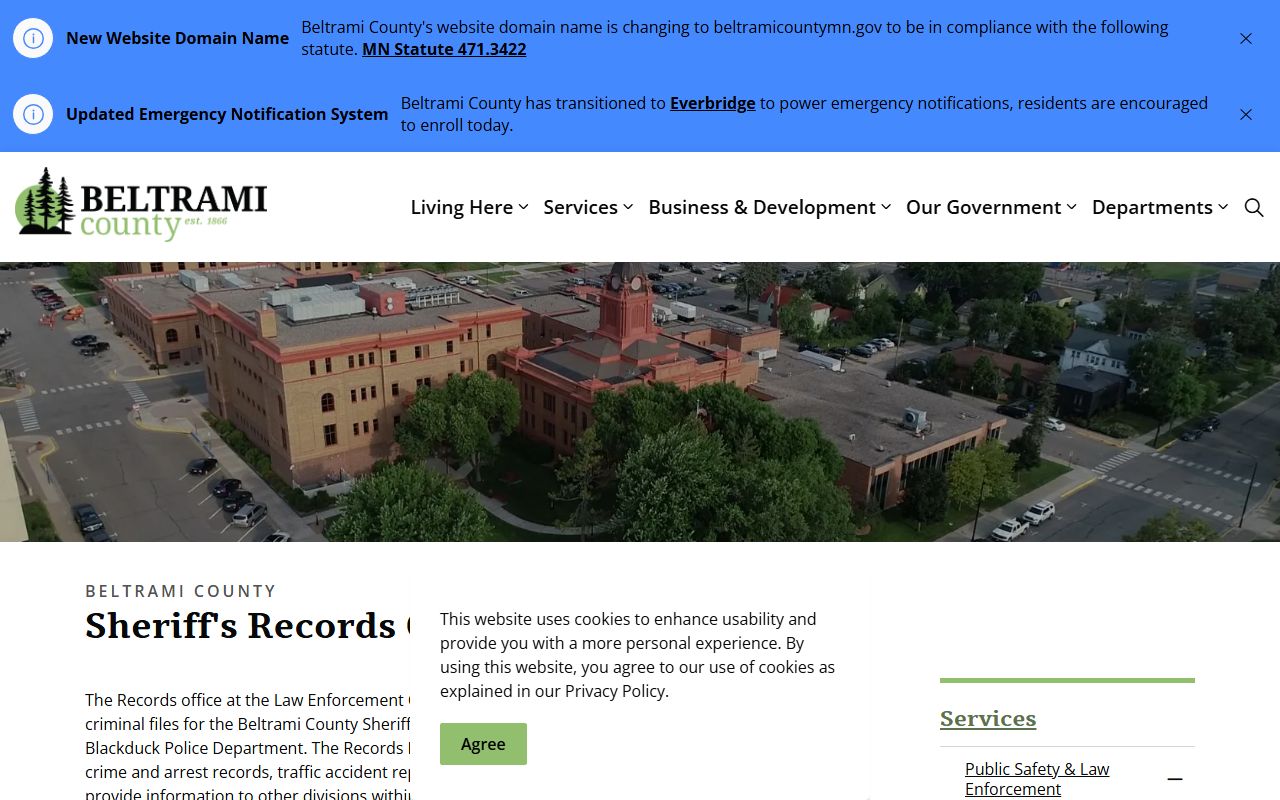
The Sheriff's Records Office is the access channel for police reports and law-enforcement data that do not live in MCRO.
Find Beltrami Arrest Records and Charges
No single search covers every Beltrami County arrest record and every court charge. Use the source that matches the record type. The Beltrami County Inmate Locator is for current or recent local custody. MCRO Case Search is for court cases and filed charges. Sheriff's Records handles arrest reports, incident reports, traffic accident reports, citations, and public data requests. The BCA Public Criminal History Search is for official public conviction history.
- For custody, search the Beltrami Inmate Locator or call the Adult Correction Center.
- For filed charges, search MCRO by case number first, or by name with Beltrami selected as the court location.
- Open the case details and review the charge list, Register of Actions, and disposition entries.
- For an arrest report or incident report, use the Sheriff's Records Office data request process.
- For statewide public conviction history, use BCA Public Criminal History Search.
MCRO search limits still apply. Pending criminal, traffic, and petty misdemeanor cases with no conviction may not return by defendant-name search, but they may return by case number. That is why a citation, court file number, or calendar case number can be more useful than a name alone.
The search path also depends on timing. A person may appear in the jail locator before a formal complaint appears in the court record. A charge may appear in MCRO after filing even if the related arrest report is not publicly released. A statewide BCA conviction-history entry may not appear until after a conviction-level outcome is reported. Beltrami County arrest records and court charge records therefore should be checked by source and by stage, not treated as one combined database.
Charges After Arrest Documents
The charging document is the point where the arrest-to-court pathway becomes a court record. In Beltrami County, law enforcement may make an arrest or issue a citation, but the prosecutor decides what formal counts to file when prosecution moves forward. The District Court case then tracks those filed counts through hearings, plea, dismissal, amendment, conviction, sentencing, or other disposition.
| Document | Who Uses It | What It Does |
|---|---|---|
| Complaint | Common criminal charging document | Starts the court case and lists the filed count or counts, offense facts, and statutory basis when public. |
| Information | Prosecutor-filed charging document | Sets out formal charges after prosecution review when used under Minnesota criminal procedure. |
| Indictment | Grand jury charging document | Used for serious matters when charges are returned by a grand jury. |
Not every arrest creates the same kind of charge record. Some matters are declined, some are cited, some are charged later, and some cases change after the first filing.
Beltrami Charge Status Table
A charge status tells what happened to a filed count at a given point in the court case. Status should not be read without the full docket and disposition. One arrest can produce more than one charge, and each count can move differently. A case may have one dismissed count, one amended count, and one conviction-level outcome.
| Status | What It Means |
|---|---|
| Pending | The filed charge remains open and no final disposition has been entered. |
| Amended | The charge was changed by court filing or order, often to correct, add, reduce, or revise a count. |
| Reduced | The charge level or offense was lowered as part of a plea, amendment, or court action. |
| Dismissed | The court record shows the count or case was dismissed and should not be read as a conviction. |
| Convicted | The case reached a conviction-level outcome by plea, verdict, or other court disposition. |
| Probation Violation | A later court event alleges failure to comply with sentence or probation conditions. |
Charges vs Convictions
Beltrami County arrest records, court charges, and conviction history answer different questions. An arrest shows law-enforcement action. A charge shows a formal accusation filed in District Court. A conviction shows a court outcome after plea, verdict, or other conviction-level disposition. Minnesota's inmate locator disclaimer also warns that booking into jail does not establish guilt or conviction.
| Point | Charge | Conviction |
|---|---|---|
| Meaning | A filed accusation in court. | A court outcome after plea or verdict. |
| Where found | MCRO case details, complaint, docket, and charge entries. | Disposition, sentencing, BCA public conviction history when reported. |
| Can change | Yes, charges may be amended, reduced, or dismissed. | May be affected by appeal, correction, expungement, or later relief. |
| Use caution | Does not prove guilt. | Still requires exact case and sentence context. |
Sheriff Records Request Channels
Beltrami County Sheriff's Records is the local channel for law-enforcement records tied to arrests and incidents. The office processes crime and arrest records, traffic accident reports, citations, and related documents for the Sheriff's Office, County Attorney, court system, other law-enforcement agencies, and the public. It also reports crime statistics to the BCA. Court charges and court outcomes are not requested through the same office unless the requested item is a law-enforcement file.
Records are released only as allowed by the Minnesota Government Data Practices Act and law-enforcement data rules. Beltrami County withholds confidential reports, juvenile reports and names, social-services reports, vulnerable-adult matters, victim names, and active-investigation material if release could jeopardize safety or welfare. Private data requires proof of legal right and photo identification.
The county data request form asks for requestor information, a specific information request, the person or subject involved, delivery preference, and signature. Requestor information is optional for public data, but a phone number or email may be needed for the office to arrange inspection or send copies. For private information, staff must verify identity or legal authority before release. The form is the better route when a phone call cannot produce the report or when the request needs a clear written scope.
| Channel | Beltrami Details |
|---|---|
| In person or mail | Beltrami County Law Enforcement Center, 613 Minnesota Ave NW, Bemidji, MN 56601. |
| Phone | Records Division 218-333-4187; dispatch 218-333-9111. |
| Fax | 218-333-4271. |
| sheriff.records@co.beltrami.mn.us. | |
| Form | Beltrami County Law Enforcement Center Data Request Form. |
The Minnesota law-enforcement data statute is included in the arrest and charge records image set.
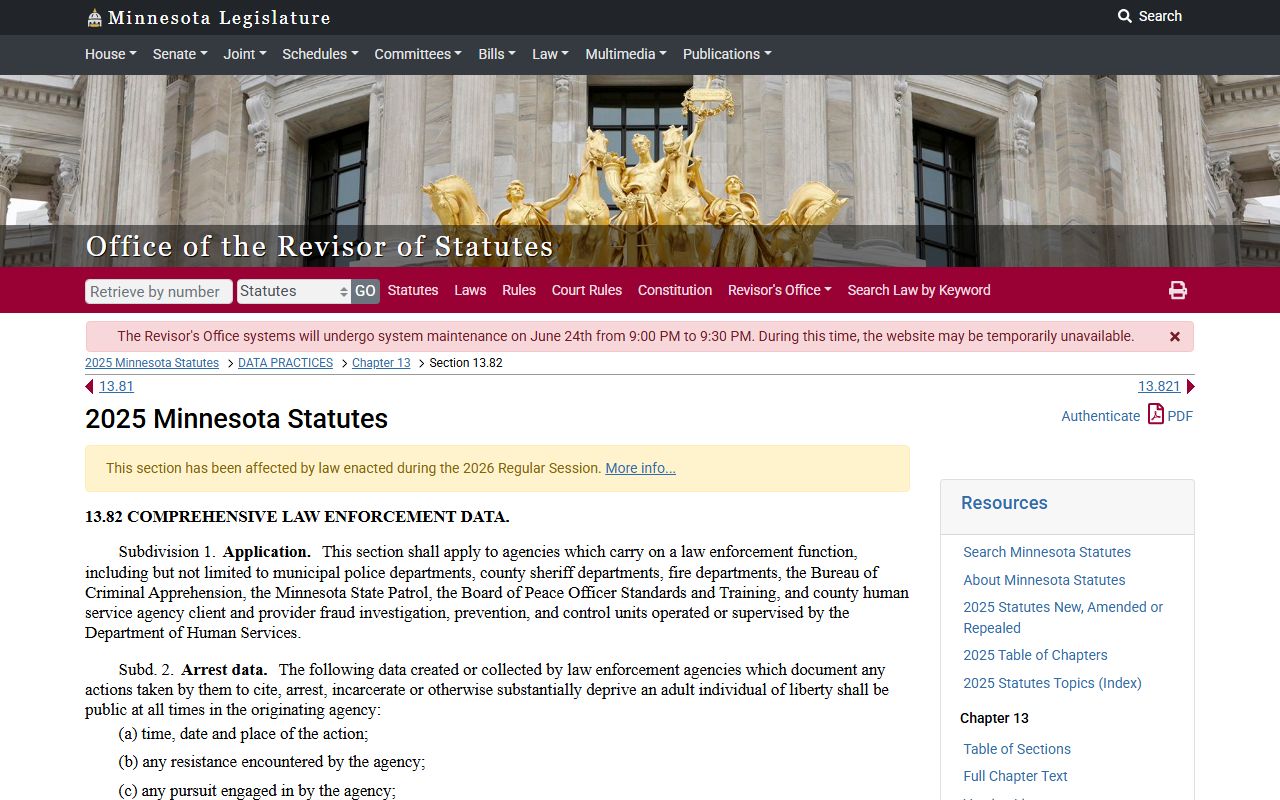
Section 13.82 explains why some arrest and investigative data can be public while other parts remain restricted.
Beltrami County Charging Role
The Beltrami County Attorney is the local prosecution office in the charging workflow. The county elected-officials page names County Attorney David Hanson and explains that the office represents the county before Minnesota courts and other authorized forums. The County Attorney page also says the office does not provide legal opinions to private individuals and does not provide opinions to private parties in civil matters. If someone believes they are a crime victim, the county directs them to local law enforcement.
That division of roles is important for arrest records and court charges. Law enforcement creates the arrest or incident record. The prosecutor decides whether to file formal criminal charges. Beltrami County District Court tracks the filed counts, appearances, pleas, disposition, sentence, and probation events. Public defender information is state-administered through the Minnesota Board of Public Defense, with public defender offices listed in the historic courthouse building source.
The Beltrami County elected officials page is assigned to this page's manifest.
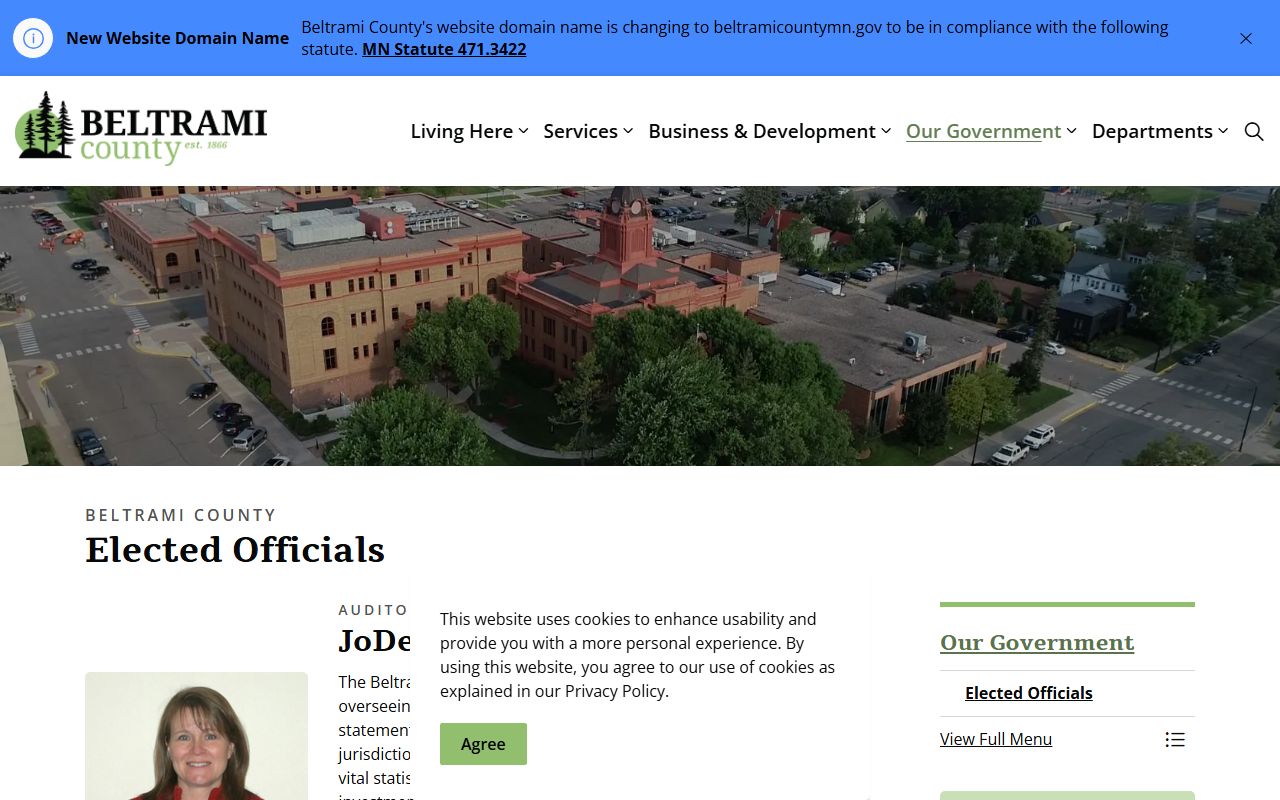
The elected-officials source supports the local prosecutor, sheriff, and county roles that sit around the arrest-to-charge pathway.
Restricted Beltrami Charge Records
Arrest and charge records can be public, private, sealed, expunged, or restricted depending on the record holder and case type. Juvenile delinquency records are generally confidential, with limited public access in certain felony matters involving a youth at least 16 at the time of the alleged offense. MCRO excludes Child Protection and Juvenile Delinquency Felony 16 case types from remote search. Domestic abuse order-for-protection and harassment restraining order case types are not available remotely through MCRO.
Law-enforcement restrictions can be different from court restrictions. An arrest report may include investigative material, victim information, juvenile names, private data, or safety-sensitive details that are withheld even if a public court charge exists. A court file may show a complaint and disposition while the underlying report remains partly nonpublic. For that reason, a user should not assume that MCRO access means the full police report is open, or that a restricted police report means no court case was filed.
| Point | Sealed | Expunged |
|---|---|---|
| Public view | Not open to ordinary public inspection. | Sealed from public access under Minnesota expungement law or eligible automatic process. |
| Applies to | Court records, juvenile matters, confidential categories, or court-ordered limits. | Eligible criminal records under chapter 609A or section 609A.015. |
| Still may exist | Yes, authorized access may remain. | Yes, agency records may require separate analysis. |
| Local path | Ask District Court Administration about court access and orders. | Identify the case number and follow Minnesota Judicial Branch expungement procedures. |
Note: Court expungement and law-enforcement data restrictions are related, but they are not always the same process.